
Event
The 10th International USERN Congress and Prize Awarding Festival: Day 2
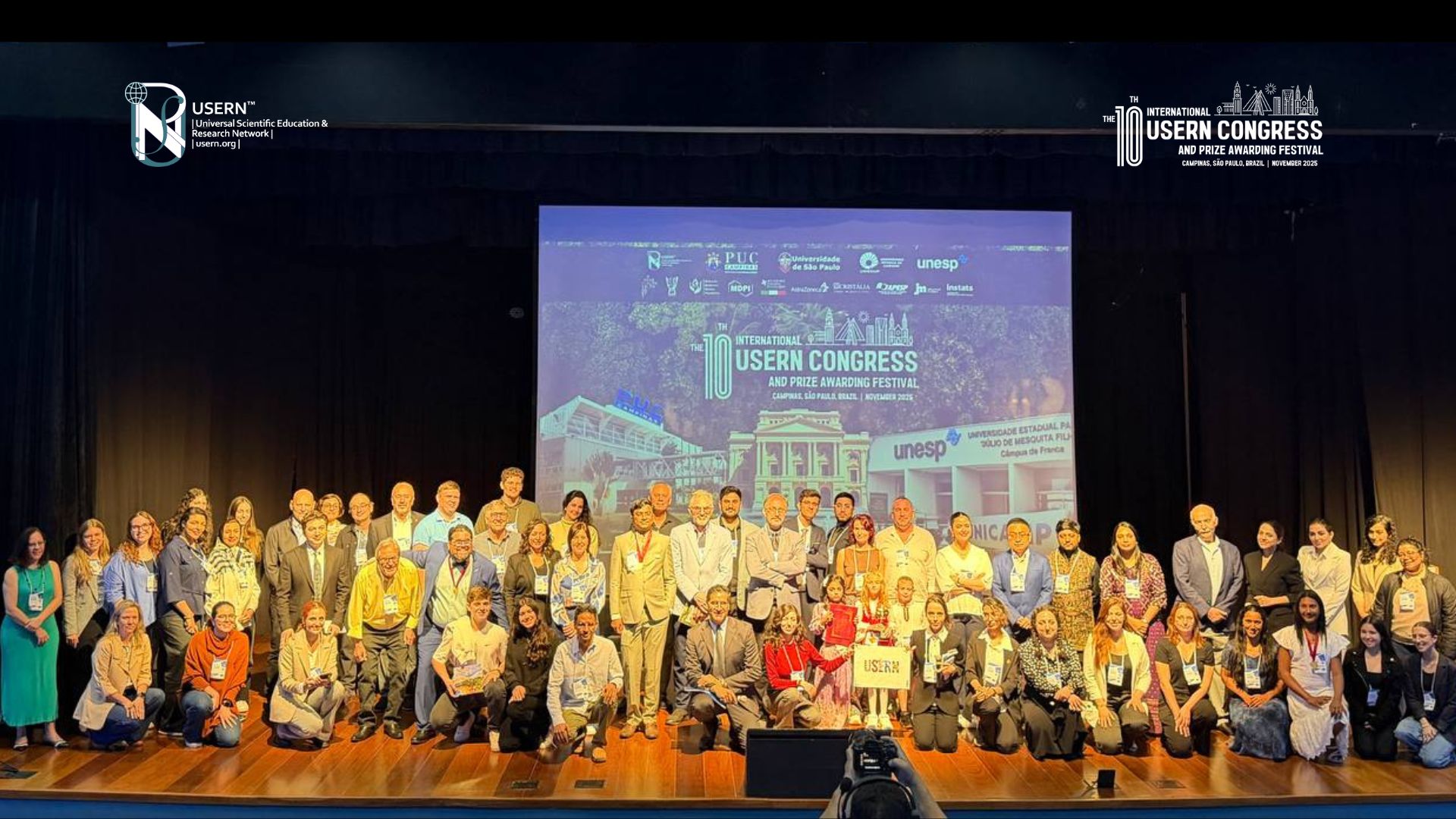
The 10th International USERN Congress and Prize Awarding Festival Day2
The second day of the 10th International USERN Congress continued with an atmosphere of curiosity, collaboration, and scientific excellence. Held on November 9, 2025, in Campinas, São Paulo, Brazil, the congress once again united researchers, professionals, and students from around the world under the inspiring theme “ONEHealth: From Formal to PsychoMedical Sciences.”
The morning in-person keynote sessions opened with compelling lectures within the themes “Interdisciplinary Neuroscience Research: From Neurobiology to Neuroimaging” and “Interdisciplinary Environmental and Biomedical Research: From Etiology to Clinical Practice.”
-
Prof. George Perry (USA) — "Oxidative stress in the origin of Alzheimer’s disease"
-
Prof. Alexander Leemans (The Netherlands) — "From diffusing water molecules to the blueprint of brain connections"
-
Prof. Maziar Moradi-Lakeh (USA) — "The impacts of climate change on health"
-
Prof. Tiziana Cappello (Italy) — "Effects of microplastics and associated contaminants on the embryo-larval development and reproductive health of different aquatic species"
-
Prof. Anton Tkachenko (Czech Republic) — "How do red blood cells die? Novel insights into eryptosis, a suicidal cell death of erythrocytes: its machinery, role in health and disease, druggability"
In parallel, the morning virtual keynote sessions engaged global audiences with insightful talks under two interdisciplinary themes: “Translational Formal and Chemical Sciences: From Artificial Intelligence to the Molecules” and “Translational Medical and Public Health: The Progress and the Challenges.”
-
Prof. Fabien Lotte (France) — "Artificial Intelligence for Neurotechnologies: opportunities and biases"
-
Prof. Artemi Cerda (Spain) — "Soil erosion as a consequence of forest fires"
-
Prof. Artem Oganov (Russia) — "Chemical reactivity of the elements: simple model and non-trivial implications"
-
Prof. Pablo Artal (Spain) — "Vision with infrared two-photon vision"
-
Prof. Christopher Wlezien (USA) — "Public Updating of (Economic) Perceptions: How History Matters"
- Prof. Filip Dochy (The Netherlands) — "The future of learning in universities of tomorrow"
- Prof. Reza Malekzadeh (Iran) — "Updates on prevention of premature death"
The afternoon in-person keynote session continued with inspiring talks focusing on “Interdisciplinary Immune Research: From Bench to Bedside in Immune-Related Diseases.”
-
Prof. Nima Rezaei (Iran) — "Memorial Talk: The JMF Warning Signs for Diagnosis of Inborn Errors of Immunity"
-
Prof. Carolina Sanchez Aranda (Brazil) — "Immunologist and Secondary Immunodeficiency"
-
Prof. Antonio Condino-Neto (Brazil) — "Implementation of newborn screening for Inborn Errors of Immunity in Brazil"
-
Prof. Marcelo Benhack (Brazil) — "Cancer de Prostata e Longevidade: Qualidade de Vida e Teste Epigenético"
-
Prof. Carla M. Salgado (Brazil) — "Avaliação e Aconselhamento Genético do Paciente com Diagnóstico de Câncer"
- Dr Niloufar Yazdanpanah (Austria) — "Allergy in Inborn Errors of Immunity: Translation of Advances in Allergy Treatment to Inborn Errors of Immunity"
In parallel, the afternoon virtual session explored new frontiers in science through the theme “Translational Immunology and Cancer: Updates and Challenges.”
-
Prof. Sara De Biasi (Italy) — "Immunometabolic Signature of Antigen-Specific T Cells After Vaccination"
-
Prof. Fabiana Corsi-Zuelli (UK) — "Immunopsychiatry and Psychosis: Connecting Inflammation, Immunity, and the Brain"
-
Prof. Moein Moghimi (UK) — "Overcoming acute complement responses to nanomedicines"
-
Prof. Domenico Pratico (USA) — "Role of miRNAs in tauopathy and related dementias"
Participants also joined an inspiring Meet the Expert Session with Prof. Timothy Lyons (USA), enabling direct dialogue on research innovation, scientific mindset, and interdisciplinary impact.
Throughout the day, three sessions of in-person oral presentations and three virtual oral presentation sessions created meaningful opportunities for researchers, especially young scientists, to showcase their studies, receive feedback, and form new collaborative connections.
The second day of the 10th International USERN Congress concluded as a celebration of knowledge, innovation, and global scientific unity, a powerful reflection of USERN’s commitment to promoting “Science without Borders.”